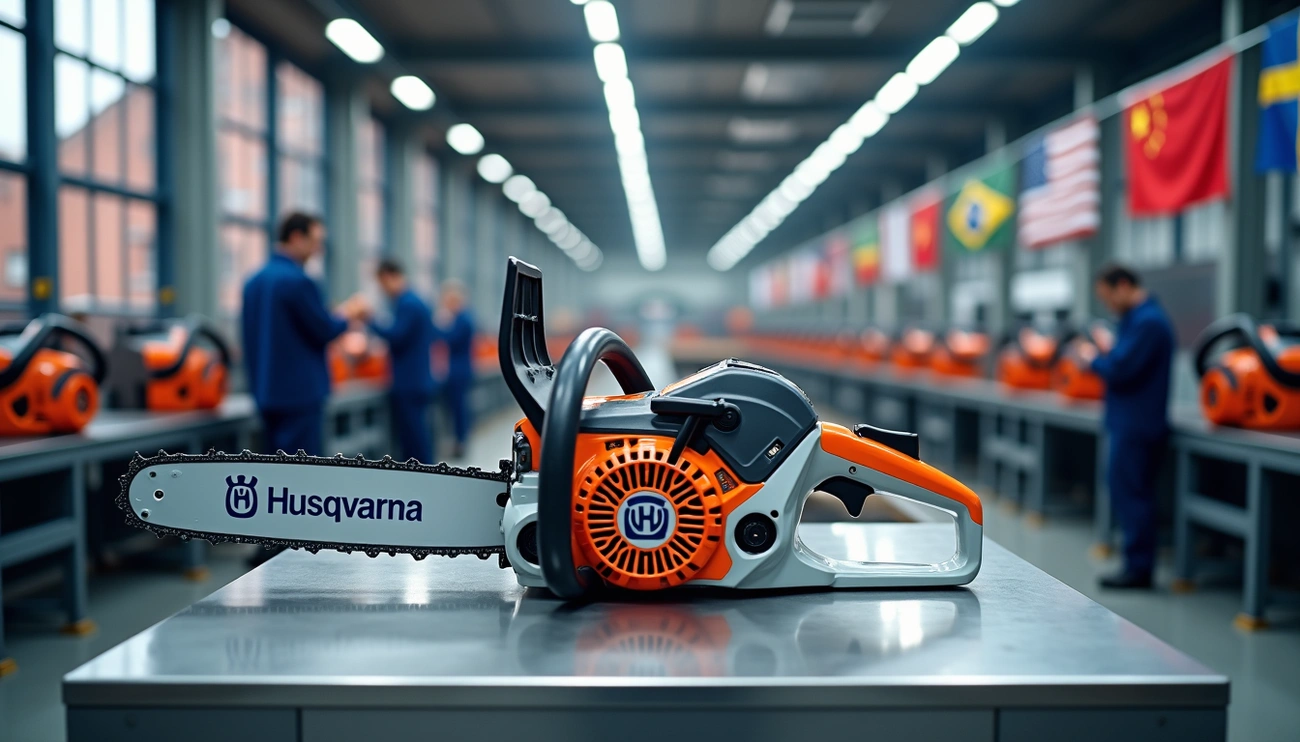
Husqvarna chainsaws are made in several countries worldwide. Core design and manufacturing originate in Sweden, while additional production occurs in the United States, Brazil, China, and parts of Europe such as Poland. Professional models are commonly built in Sweden or Brazil, while entry-level chainsaws are often produced in China under Husqvarna quality standards.
The Swedish Roots of Husqvarna
The story of Husqvarna, Sweden’s oldest industrial company, begins in 1689 at a picturesque waterfall in the town of Huskvarna. Originally established as the “Jönköping Rifle Factory” by decree of the Swedish monarch, this site was strategically chosen for its valuable hydropower necessary for weapons manufacturing. Indeed, the Husqvarna country of origin remains deeply rooted in this small Swedish town, whose name (formerly spelled “Husqvarna”) the company proudly bears to this day.
From muskets to chainsaws: a 330-year journey
Initially producing approximately 1,500 musket pipes annually, the company’s precision engineering skills would eventually lead them far beyond weaponry. Throughout the late 19th century, as military contracts declined, Husqvarna embarked on an ambitious diversification journey, transforming from a rifle factory into a consumer goods powerhouse.
Their product evolution tells a fascinating story of innovation:
- Sewing machines (1872)
- Hunting weapons (1877)
- Wood stoves (1884)
- Bicycles (1896)
- Motorcycles (1903)
The watershed moment for modern Husqvarna came in 1959 when the company manufactured its first chainsaw, known as the Husqvarna 90. Notably, this chainsaw was designed by iconic Swedish designer Sixten Sason, who cleverly incorporated motorcycle muffler technology to achieve significantly lower noise levels than competitors.
Why Huskvarna, Sweden still matters today
Despite global expansion, the heart of who makes Husqvarna chainsaws remains in Sweden. The original waterfall site where the company began over 330 years ago continues to be operational, serving as both a physical and spiritual anchor for the brand. Furthermore, many products are still manufactured at this historic location.
In fact, the company’s Swedish heritage directly influences where Husqvarna chainsaws are manufactured today. While production now spans multiple continents, Sweden remains the hub for premium components, research and development, and top-tier professional models. This commitment to their roots ensures that even as where Husqvarna products are made has expanded globally, the company maintains the engineering excellence and quality standards established over three centuries ago.
Husqvarna’s Global Manufacturing Network
Husqvarna has strategically established manufacturing facilities across multiple continents, creating a sophisticated global production network that balances expertise, market access, and cost efficiency. This worldwide manufacturing approach allows the company to maintain both its Swedish quality standards and competitive pricing.
Sweden: premium components and R&D
At the core of Husqvarna’s production philosophy remains their Swedish heritage. The original Huskvarna facility continues to specialize in manufacturing high-end components and professional-grade chainsaws. Moreover, Sweden serves as the central hub for research and development, where engineers design the next generation of cutting technology. This facility maintains the premium craftsmanship that has defined the brand for centuries.
USA: high-volume production and exports
The United States represents both Husqvarna’s largest market and a critical manufacturing center. American facilities focus primarily on high-volume production of mid-range and professional models. These plants supply not only the North American market but also export units worldwide. Because of their strategic importance, US facilities receive substantial investment in automation and quality control systems.
China: cost-effective entry-level models
As part of their market diversification strategy, Husqvarna operates multiple plants throughout China. These facilities specialize in producing entry-level and consumer-grade chainsaws at competitive price points. Although manufactured overseas, these models still undergo Husqvarna’s quality testing protocols to ensure they meet brand standards, albeit with specifications appropriate for occasional rather than professional use.
Brazil and France: regional specialization
To serve specific regional markets effectively, Husqvarna maintains specialized facilities in both Brazil and France. The Brazilian plant focuses on chainsaw models adapted for South American forestry conditions and consumer preferences. Meanwhile, French operations concentrate on manufacturing components and assembling models tailored to European regulations and usage patterns. This regional approach allows for customization to local needs without sacrificing the core engineering principles that define who makes Husqvarna chainsaws.
Where Are Husqvarna Chainsaws Made?
Examining exactly where are Husqvarna chainsaws made requires understanding their sophisticated global production strategy. The company divides manufacturing based on model type, market demands, and quality considerations across four primary locations.
Power head production in Sweden
The heart of premium Husqvarna chainsaws—the power head—comes directly from Sweden. This critical component houses the engine and represents the core technology behind the chainsaw’s performance. Swedish facilities leverage the country’s engineering expertise and rigorous quality controls to produce these essential components. The company’s dedication to Swedish craftsmanship remains evident through their investment in a new saw chain factory in Huskvarna, supported by a SEK 425 million (EUR 49 million) loan specifically for this purpose.
Final assembly in the USA
For many models, especially those sold in North America, power heads journey from Sweden to American facilities where they’re paired with locally produced components. Specifically, Oregon bars are fitted during final assembly in the United States. Interestingly, despite accounting for only 40% of global sales, US facilities produce 54% of Husqvarna’s total output—highlighting the export significance of American-made chainsaws.
Chinese plants for budget models
Husqvarna operates six production plants throughout China, primarily focusing on cost-optimized, entry-level chainsaws. These facilities enable the company to maintain competitive pricing while adhering to brand quality standards. Chinese manufacturing predominantly serves the Asian market with affordable models that maintain functional reliability.
Brazilian facility for Latin America
The company’s South American production is anchored in Brazil, where they’ve established a specialized facility dedicated to chainsaws and outdoor power equipment. This strategic location allows Husqvarna to serve the Latin American market effectively, producing models specifically designed for regional needs. Through this network of facilities, Husqvarna balances manufacturing efficiency with product specialization, ensuring that regardless of where their chainsaws are manufactured, they maintain consistent quality standards.
Does Manufacturing Location Affect Quality?
Quality varies substantially based on where Husqvarna chainsaws are manufactured. For many buyers, country of origin directly impacts performance expectations and value.
Swedish-made: top-tier performance
Swedish-manufactured Husqvarna chainsaws represent the gold standard in precision engineering. These premium models feature components produced under rigorous quality control in state-of-the-art facilities. The X-Cut® chainsaw chain, manufactured entirely in Huskvarna, Sweden, showcases this commitment to excellence—with every step from raw steel to finished product handled in a facility equipped with integrated testing labs and an on-site sawmill for real-world trials. Consequently, Swedish-made models command higher prices due to their uncompromising standards and superior craftsmanship.
US-made: rugged and reliable
Chainsaws assembled in the Nashville, Arkansas plant blend Swedish-engineered components with locally sourced parts like Oregon bars. According to user feedback, these American-made models are considered robust and dependable workhorses. Essentially, they provide an excellent balance of Swedish precision with American manufacturing efficiency, resulting in products that feel substantial and perform consistently in demanding conditions.
China-made: affordable and functional
Husqvarna operates six Chinese manufacturing facilities primarily focused on entry-level, cost-optimized models. Although built to meet basic brand standards, these chainsaws are designed for lighter-duty tasks and occasional use rather than professional applications.
How to check your chainsaw’s origin
Examine the product label or serial number for manufacturing details. This information typically appears on the chainsaw’s body or packaging documentation.
Conclusion
After exploring Husqvarna’s remarkable journey from a Swedish musket factory to a global chainsaw powerhouse, we can see how their manufacturing strategy balances heritage with worldwide expansion. While the company proudly maintains its Swedish roots, they have clearly established a sophisticated international production network spanning multiple continents.
Understanding where your Husqvarna chainsaw comes from actually matters significantly. Swedish-made models represent the pinnacle of quality with meticulous attention to detail and premium components. Meanwhile, American-assembled units offer excellent reliability by combining Swedish engineering with efficient US manufacturing practices. Although China-produced entry-level models provide affordability for casual users, they generally lack the durability required for professional applications.
This distinction between manufacturing locations helps explain the wide price range across the Husqvarna lineup. Professional users requiring daily performance will benefit most from investing in Swedish or American-made models. Occasional homeowners might find Chinese-manufactured units perfectly adequate for their limited needs.