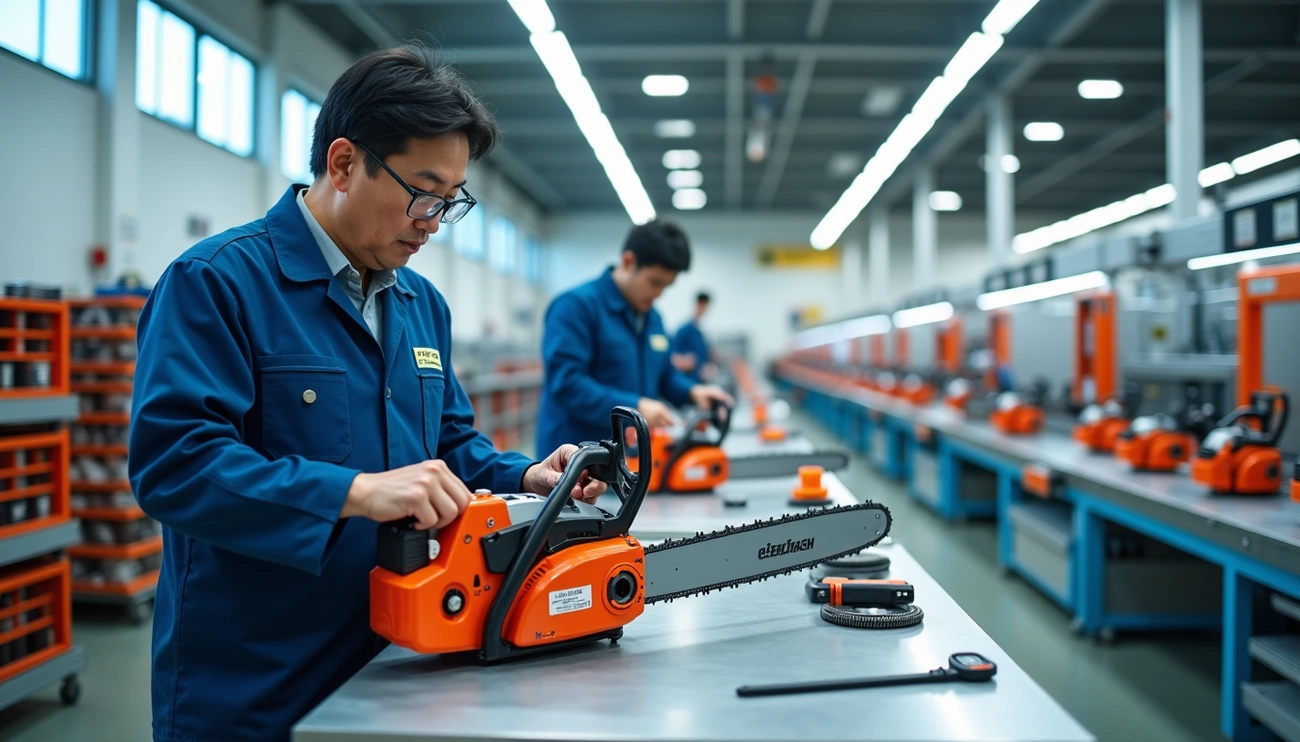
Echo chainsaws are primarily designed and manufactured in Japan, with major production facilities in Morioka and Yokosuka. Some assembly and component manufacturing also take place in China and the United States, all produced under strict Japanese quality standards.
The Origins of Echo Chainsaws
The story of Echo chainsaws begins in the aftermath of World War II, when the Asamoto brothers established Kyoritsu Noki Company Ltd. on September 8, 1947. Initially, the company’s primary focus was addressing Japan’s severe food shortages by manufacturing agricultural machinery that could improve farming efficiency.
From Kyoritsu Noki to Kioritz Corporation
During its early years, Kyoritsu Noki concentrated on developing power dusters, mist blowers, and pest control machinery. Their first breakthrough product was a revolutionary hand-crank powered spreader designed for transmitting dry chemicals to crops. Throughout the 1950s and 1960s, the company refined its expertise in small engine technology while gradually expanding its product range.
A significant milestone occurred in 1971 when Kyoritsu Noki officially changed its name to Kioritz Corporation. This transformation coincided with the launch of the CS-302, the company’s first professional-grade chainsaw, notable for its distinctive orange casing. The rebranding represented not just a name change but also a strategic shift toward forestry equipment.
The birth of the Echo brand
Interestingly, the now-famous Echo name first appeared several years before the company rebranding. In 1963, Kyoritsu Noki released the CS-80 chainsaw—the first product to bear the “Echo” name. However, it wasn’t until 1978 that the Echo brand name was formally established as the company’s primary identity.
The Echo brand quickly gained traction in North America. In 1972, the company established its presence in Northbrook, Illinois, servicing the outdoor power equipment industry with high-performance 2-cycle engines and handheld products. By 1975, Echo had cemented its reputation for innovation by introducing the world’s first backpack blower, the PB-9.
Early innovations in compact engine design
Echo’s engineering philosophy centered on creating durable, efficient tools for demanding work environments. Their early chainsaws featured robust housings, dependable performance, and innovative compact engines specifically designed for heavy outdoor workloads.
The 1970s proved particularly consequential for Echo’s development. During the 1973 oil crisis, demand surged for small, affordable chainsaws as people turned to firewood for heating their homes. Echo responded with the CS-302, a chainsaw that would enjoy a remarkable 20-year production lifespan.
This focus on practical innovation continued throughout the decade, culminating in the introduction of the world’s first handheld blower (the PB-200) in 1978. These achievements firmly established Echo’s reputation as a pioneer in compact engine technology that continues to influence who makes Echo chainsaws today.
Who Makes Echo Chainsaws Today
Today, every Echo chainsaw comes from the Yamabiko Corporation, a Japanese powerhouse in outdoor power equipment that oversees the brand’s global production and maintains its reputation for reliability.
The Yamabiko Corporation explained
Yamabiko Corporation formed in 2008 through the merger of two established Japanese manufacturers: Kioritz Corporation (Echo’s parent company) and Shindaiwa Incorporated. This strategic union combined Kioritz’s mastery in engine and forestry equipment with Shindaiwa’s expertise in machining and industrial engineering. Consequently, this partnership created a unified global manufacturer with enhanced technical capabilities and streamlined production processes.
The corporate headquarters remains in Tokyo, Japan, yet production now spans across multiple strategic locations worldwide. Yamabiko implemented a vertically integrated manufacturing philosophy for Echo products, utilizing a combination of automated systems and skilled labor to ensure consistent quality across all regions.
The 2009 merger with Shindaiwa
The integration of these companies progressed rapidly throughout 2009. By April 1, 2009, Shindaiwa transferred its sales and marketing responsibilities for Europe, Asia, and the Middle East back to Japan. Furthermore, the consolidation plan called for all operations of both companies to be fully merged in Japan by October 1, 2009.
The North American operations underwent significant changes as well. Eventually, all Shindaiwa operations would merge with Echo’s facility in Lake Zurich, Illinois. This consolidation was completed by October 1, 2009, creating a more efficient organization with lower operational costs.
Following the merger, Echo Incorporated expanded its Lake Zurich facility with a 129,000-square-foot warehouse addition. This expansion accommodated the consolidated Shindaiwa product distribution for North America and Latin America. Notably, this move allowed Echo to gradually transfer manufacturing of Shindaiwa products from Japan to Lake Zurich.
Echo’s global leadership in outdoor tools
Since the formation of Yamabiko Corporation, Echo chainsaws have become globally recognized for their consistency, durability, and reliable performance. The brand maintains a focused product lineup that serves various markets, from homeowners to professional arborists.
Although the Shindaiwa product line was narrowed after the merger—including the discontinuation of Shindaiwa-branded chainsaws—Echo continues to expand its position as a leader in professional-grade outdoor power equipment.
Where Are Echo Chainsaws Manufactured?
Understanding where Echo chainsaws are manufactured reveals a sophisticated global production network spanning three continents. Under Yamabiko Corporation’s direction, these tools come to life through strategically positioned facilities worldwide.
Main production facilities in Japan
The heart of Echo chainsaw production remains in Japan, with state-of-the-art facilities in Yokosuka and Morioka. These plants focus primarily on high-precision component manufacturing and production of core engine technologies. Indeed, Echo proudly emphasizes that their chainsaws are “built in Japan with decades of experience and expertise”, highlighting the company’s commitment to traditional Japanese craftsmanship.
U.S. assembly plant in Lake Zurich, Illinois
For North American markets, Echo’s facility in Lake Zurich, Illinois plays a crucial role. This plant primarily handles assembly of components for models sold throughout the continent. Moreover, the Lake Zurich operation expanded significantly following the Yamabiko merger, with Ryan Ladley, Echo’s VP of Operations, overseeing the manufacturing processes. The facility exports parts from Japan and assembles both Echo and Shindaiwa products.
Additional manufacturing in China
Complementing these operations, Echo maintains production capacity in Shenzhen, China. This facility supports global supply chains and component production, enabling Echo to meet worldwide demand efficiently.
How global production is coordinated
Throughout its manufacturing network, Echo implements identical quality management frameworks. This standardized approach ensures consistent product performance regardless of manufacturing origin. Accordingly, whether a chainsaw comes from Japan, the US, or China, customers receive tools built to the same exacting specifications.
How Echo Maintains Quality and Sustainability
Beyond manufacturing locations, quality remains paramount for Echo chainsaws everywhere they’re made.
Standardized quality control across regions
Regardless of origin, every Echo chainsaw undergoes identical quality management protocols. This standardized framework ensures consistent performance whether produced in Japan, the United States, or China.
Use of lean manufacturing principles
Echo applies lean manufacturing philosophies throughout their production facilities. These practices minimize waste by streamlining processes and optimizing resource utilization. Such principles focus on creating value through effective workflows, careful material management, and continuous improvement.
Eco-friendly two-stroke engine technology
Currently, Echo stands as the global leader in low emission engines. Their chainsaws utilize innovative Stratified Engine technology, delivering maximum performance with minimum environmental impact. This eco-conscious engineering allows Echo to exceed increasingly stringent emission regulations without sacrificing power.
Recycling and waste reduction efforts
Echo’s commitment to sustainability shines through their impressive recycling program. Primarily, they recycle 100% of molded plastic scrap—over 400,000 pounds annually. Even dust created from the regrind process is re-pelletized and reused.
As an environmental leader, Echo installed one of Illinois’ largest solar panel arrays at their Lake Zurich facility, offsetting approximately 38% of its energy use. Thanks to these efforts, Echo received the Lake Zurich Green Business Award recognizing their dedication to creating a more sustainable future.
Conclusion
Throughout our exploration of Echo chainsaws, we’ve uncovered a rich history dating back to post-war Japan and continuing through today’s global manufacturing network. Undoubtedly, the brand’s Japanese heritage remains a cornerstone of its identity, with primary engines still crafted in facilities at Yokosuka and Morioka. Meanwhile, the Lake Zurich, Illinois plant serves North American markets with assembly operations, and additional manufacturing in China supports worldwide distribution.
Echo’s evolution from Kyoritsu Noki to Kioritz Corporation and finally to a brand under Yamabiko Corporation demonstrates their commitment to growth and adaptation. The 2009 merger with Shindaiwa particularly strengthened their position as a global leader in outdoor power equipment.
What sets Echo apart from competitors, however, goes beyond manufacturing locations. Their standardized quality control ensures consistent performance regardless of where a chainsaw originates. Additionally, their dedication to sustainability shines through their eco-friendly engine technology and impressive waste reduction efforts.