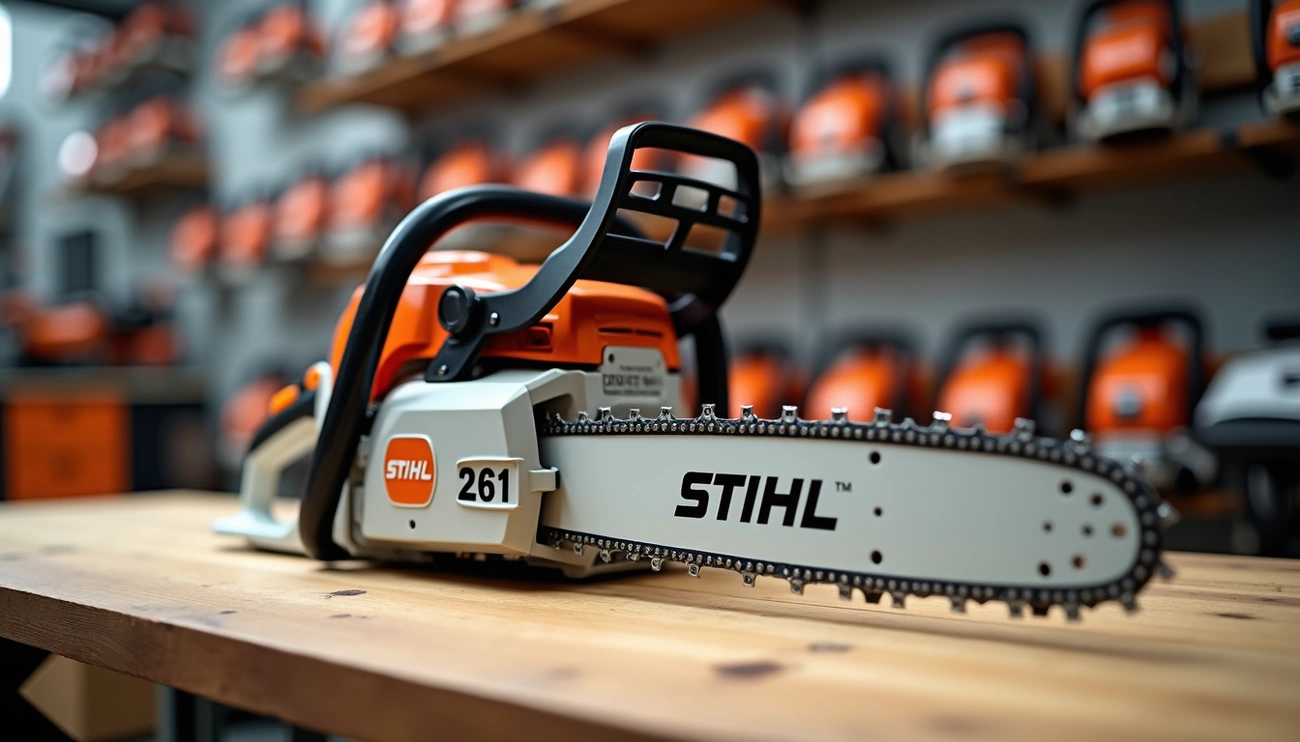
What Does MS Mean on Stihl Chainsaws? A Simple Guide
On STIHL chainsaws, MS means Motorsäge, the German word for chainsaw. This label identifies a gasoline-powered STIHL chainsaw. Battery-powered models use the prefix MSA, electric models use MSE, and the numbers that follow, such as MS 250 or MS 462, indicate the model and power class.
What does MS mean on STIHL chainsaws?
The STIHL brand has a rich German heritage that’s reflected in its model naming system. Understanding these codes helps you identify the right chainsaw for your needs.
The origin of ‘MS’ and its German roots
The mysterious ‘MS’ prefix on STIHL chainsaws comes directly from German terminology. STIHL, a German company, uses “MS” as an abbreviation for “Motorsäge”, which literally translates to “chainsaw” in English. This naming convention highlights the company’s European origins and international reach.
Historical note: STIHL implemented the MS designation around the year 2000[71]. Before this standardization, STIHL used a simpler numeric system. For example, older models like the 017, 025, and 066 were eventually renamed to MS 170, MS 250, and MS 660. This change marked an important transition in the company’s branding approach.
MS vs MSA vs MSE: Power source explained
STIHL uses a clever extension of the basic MS code to indicate different power sources:
- MS: Stands alone for traditional gas-powered chainsaws
- MSA: Indicates battery-powered chainsaws (the “A” likely comes from “Akku,” German for battery)[52]
- MSE: Designates electric corded models (the “E” derives from “Elektro,” German for electric)[41][52]
This consistent naming pattern makes it easier to identify a chainsaw’s power source at a glance. Each type serves different purposes—gas models for heavy-duty work, battery versions for moderate jobs with portability, and electric models for light tasks near power sources.
Why STIHL uses these codes
STIHL implemented this naming system primarily to create consistency across their product line. Furthermore, the company applies similar German-derived codes throughout their entire product range:
- FS = Freischneider (Line Trimmer)
- BG = Blasgerät (Handheld Blower)
- BR = Blasgerät Rückentragbar (Backpack Blower)
- TS = Trennshleiffer (Cut Off Machine)
This systematic approach helps STIHL maintain brand identity across international markets. Additionally, the consistent naming convention makes it easier for customers worldwide to identify product categories, regardless of language barriers. The system also provides a foundation for the more detailed model numbering that follows these letter codes, creating a comprehensive identification system.
Understanding the STIHL number system
Decoding the number patterns on STIHL chainsaws helps buyers make informed decisions based on power needs and intended use. The three-digit system reveals crucial details about each saw’s capabilities and features.
First digit: Power class and engine size
The initial digit in a STIHL chainsaw model primarily indicates its power class, engine displacement, and fuel capacity. This creates a logical progression:
- 1XX series: 23.6-31.9 cc displacement, 1.0-1.5 kW power, 200-280 cc fuel capacity
- 2XX series: 35.2-55.5 cc displacement, 1.7-3.0 kW power, 280-500 cc fuel capacity
- 4XX series: 70.7-76.5 cc displacement, 4.2-4.5 kW power, 725-800 cc fuel capacity
- 6XX series: 91.1 cc displacement, 5.4 kW power, 825 cc fuel capacity
As the first number increases, so does the saw’s overall power and capability. This pattern helps users quickly identify which power class meets their requirements.
Second digit: Model type and generation
The second digit, combined with the first, creates the complete model number. Interestingly, this position often follows a professional/consumer pattern:
- Even second digits (MS 261, MS 362, MS 462) typically indicate professional-grade saws
- Odd second digits (MS 250, MS 271, MS 311) usually denote homeowner or farm/ranch models
Nevertheless, certain exceptions exist, such as the MS 180.
Third digit: Version or upgrade indicator
The third digit functions as a version identifier, always ranging from 0 to 3. Each number represents an evolution of that particular model:
- The MS 271 replaced the MS 270, demonstrating this progression
- Comparing the MS 170 to MS 171 reveals improved specifications and added features in the newer version
How the numbers evolved after 2000
Prior to 2000, STIHL chainsaws used a different numbering convention starting with zero. Around 2000, STIHL restructured their system by:
- Adding “MS” to the beginning of model names
- Moving the zero to the end position
- Examples: 017 became MS 170, 025 transformed to MS 250
This change aligned chainsaw model numbers with other STIHL products, creating brand-wide consistency. The transition explains why older and newer models with similar numbers (like the 028 and MS 280) might have completely different specifications despite numerical similarities.
What do the STIHL letter codes mean?
Beyond the basic MS prefix and numbers, STIHL chainsaws often display additional letter codes that reveal specific features and functionalities.
C = Comfort features
The “C” designation indicates comfort features that enhance user experience. These include ergonomic designs with better weight distribution, anti-vibration technology to reduce fatigue, and outstanding power-to-weight ratios. Moreover, some models feature a Master Control Lever that combines choke, throttle lock, and on-off functions for simplified operation.
B = Quick Chain Adjuster
Chainsaws marked with “B” incorporate the Quick Chain Adjuster (QCA), allowing users to adjust chain tension without tools. This tool-less system makes maintenance faster and more convenient, particularly valuable during lengthy cutting sessions.
E = Easy2Start system
The “E” code identifies STIHL’s Easy2Start™ technology, which dramatically reduces the effort needed to start the chainsaw. Specifically, an added spring between the crankshaft and start rope rotor enables users to pull slower and with less force.
M = M-Tronic engine management
“M” signifies the sophisticated M-Tronic™ system—an onboard microprocessor that automatically monitors and adjusts for changes in temperature, fuel quality, elevation, and air filter condition. This technology optimizes performance without requiring manual adjustments.
Q = QuickStop chain brake
Chainsaws featuring “Q” include the QuickStop® chain braking system, designed to stop the chain within one second if activated by the operator’s hand or inertia during kickback situations.
R and T = Handle types
The “R” indicates a wrap-around handle design, ideal for multiple cutting positions. Conversely, “T” signifies a top-handle configuration, providing better control and maneuverability, especially for arborists.
Examples of STIHL model names decoded
Let’s examine real STIHL chainsaw models to see how the naming conventions work in practice.
MS 170 vs MS 171: What’s the difference?
The MS 170 and MS 171 represent the evolution within STIHL’s entry-level models. The MS 171 offers increased displacement at 1.94 cu. in. compared to the MS 170’s 1.80 cu. in. Fuel capacity also improves from 8.5 oz. to 9.5 oz., alongside an increase in chain oil capacity from 4.9 oz. to 6.1 oz.
Notably, the MS 171 introduces tool-less fuel and oil caps with retainers plus a side-access chain tensioner—features absent in the MS 170. Both models remain effective for tasks like yard cleanup, trimming small trees, and cutting firewood. However, the MS 171 delivers a smoother cutting experience during extended use thanks to its enhanced anti-vibration features.
MS 261 C-M: What each part means
The MS 261 C-M exemplifies STIHL’s professional-grade offering with multiple feature codes. The “MS” identifies it as a gas-powered chainsaw, while “261” indicates its professional-grade power class. The “C” signifies comfort features, including redesigned cylinders and a slimmer, more ergonomic housing for better power-to-weight ratio.
Meanwhile, the “M” designation reveals the advanced M-Tronic™ engine management system. This onboard microprocessor automatically adjusts for varying conditions including elevation, temperature, fuel quality, and dirty filters—optimizing performance without manual adjustments.
MS 192 T C-E: A top-handle model explained
The MS 192 T C-E represents STIHL’s specialized arborist offering. The “T” indicates the top-handle design specifically created for in-tree use. At just seven pounds, this lightweight saw provides excellent maneuverability for climbing arborists.
The “C” again denotes comfort features, while “E” identifies the Easy2Start™ system—particularly valuable when starting the saw 40 feet above ground. This specialized model includes a retractable carry ring for climbing and operates with a 30.1 cc displacement engine generating 1.7 bhp.
Conclusion
Understanding the Stihl chainsaw model naming system ultimately helps you make better purchasing decisions. The German roots of this iconic brand shine through their “MS” designation, which simply means “Motorsäge” or chainsaw in English. Meanwhile, MSA indicates battery power, and MSE signifies corded electric models.
Additionally, the numerical system provides crucial information about each saw’s capabilities. The first digit reveals power class and engine size, the second typically distinguishes between professional and consumer models, while the third indicates version updates. Letter codes such as C, B, E, M, Q, R, and T further specify special features ranging from comfort enhancements to specialized handle designs.
Consequently, a model like the MS 261 C-M tells you it’s a gas-powered, professional-grade chainsaw with comfort features and M-Tronic engine management. This knowledge proves especially valuable when comparing similar models or determining which saw best matches your specific needs.