Why Were Chainsaws Invented? The Shocking Medical Truth
Chainsaws were invented in the late 18th century to assist with difficult childbirths, not for cutting trees. Scottish doctors created an early hand-cranked chainsaw to perform symphysiotomy, a surgical procedure that cut pelvic bone to widen the birth canal. The tool later evolved into modern chainsaws after the procedure declined.
The Shocking Medical Origin of Chainsaws
The origins of the chainsaw reveal a surprisingly gruesome chapter in medical history. Contrary to popular belief, this tool was born not from forestry needs but from a desperate attempt to improve survival rates in one of life’s most dangerous experiences: childbirth.
Why childbirth was so dangerous in the 18th century
Childbirth in the 18th century was a harrowing experience with mortality rates that seem unimaginable today. Between 1 and 1.5 percent of all births resulted in the mother’s death from complications like exhaustion, dehydration, infection, hemorrhage, or convulsions. Since women typically gave birth to between five and eight children, their lifetime risk of dying in childbirth ran as high as 1 in 8.
Moreover, parish registers from pre-industrial England (1650-1800) show maternal mortality averaged 10 per 1,000 births – 50 times higher than contemporary rates. In metropolitan London during this period, an astonishing two-thirds of children died before reaching age five, with three-quarters of these deaths occurring before their second birthday.
Several factors made childbirth particularly dangerous:
- Lack of antibiotics and proper hygiene practices
- No effective pain management besides alcohol
- Obstructed deliveries (such as breech births) with few intervention options
- Infections like sepsis and puerperal fever
- Poor nutritional understanding
The risk of death increased substantially after a woman’s fifth pregnancy, and Cesarean sections were rarely considered due to the extremely high risk of infection, which almost certainly meant death for the mother.
What were chainsaws originally invented for?
Around 1783-1785, two Scottish doctors named John Aitken and James Jeffray created what would become the prototype of the modern chainsaw. However, this early device bore little resemblance to today’s lumber-cutting equipment.
The original chainsaw was designed specifically for symphysiotomy—a surgical procedure to widen the pelvis during difficult childbirths. It featured a fine serrated link chain that cut on the concave side and was operated by a hand-crank. This “flexible saw” was first illustrated in Aitken’s “Principles of Midwifery or Puerperal Medicine” (1785).
Jeffray claimed to have conceived the idea independently around the same time but couldn’t produce the device until 1790. His goal was to create a surgical instrument that would allow for a smaller wound while protecting adjacent neurovascular structures during bone excision.
The role of symphysiotomy in obstructed labor
Symphysiotomy was a procedure first practiced around 1597 but gained prominence after French doctor Jean-René Sigault successfully performed it in October 1777. The procedure involved cutting through the cartilage and ligaments of the pubic symphysis joint (located above the vulva) to widen the pelvis and create more space for a baby stuck in the birth canal.
Before the invention of Aitken’s flexible chainsaw, doctors performed symphysiotomies manually using knives—a process that was not only excruciatingly painful for the mother (performed without anesthesia) but also dangerously time-consuming and imprecise.
The chainsaw significantly improved this grim procedure. Although still terrifying by modern standards, the device made the operation quicker, cleaner, and more reliable. Consequently, it helped reduce maternal and infant mortality rates by providing a faster alternative to the traditional method.
Additionally, symphysiotomies remained popular because they offered an alternative to Cesarean sections, which were considered extremely dangerous until the development of modern surgical techniques, anesthesia, and antibiotics. Interestingly, the procedure remained common in Ireland well into the 20th century, possibly due to religious concerns about limiting future pregnancies.
The First Chainsaw: Aitken and Jeffray’s Invention
The remarkable innovation of the flexible saw stands as a testament to medical ingenuity in the face of desperate circumstances. After years of witnessing mothers and infants perish during obstructed labor, two Scottish doctors created a tool that would eventually evolve into one of the world’s most recognizable power tools.
Design and function of the flexible saw
Aitken and Jeffray’s original chainsaw, created in the 1780s, bears little resemblance to its modern descendants. The device consisted of a fine, serrated chain with small cutting teeth arranged in an oval loop. The chain was stretched between two wooden handles at opposite ends, somewhat resembling a modern wire saw used by survivalists. The cutting action occurred on the concave side of the chain rather than the outside as in modern chainsaws.
What made this invention truly innovative was its flexibility. Unlike rigid bone saws of the era, this chain could be maneuvered around curves and through tight spaces—a critical feature for navigating the complex anatomical structures of the pelvis. The user would wrap the chain around the target bone or cartilage, then pull the handles back and forth in a reciprocating motion, allowing the teeth to gradually cut through tissue.
The earliest documented illustration of this device appeared in Aitken’s “Principles of Midwifery or Puerperal Medicine” published in 1785. His design showed a relatively simple mechanism featuring metal links connected in a chain-like formation. As a result, this initial version required considerable physical effort to operate effectively.
Jeffray later refined the design with a hand-crank mechanism that provided mechanical advantage, making the cutting action more efficient and controlled. His version emerged around 1790, featuring improvements that allowed for more precise incisions while reducing operator fatigue during lengthy procedures.
How it improved surgical outcomes
Prior to the flexible saw’s invention, surgeons performing symphysiotomies relied on unwieldy knives and rigid bone saws that made precise cuts nearly impossible. These crude tools often resulted in excessive tissue damage, uncontrollable bleeding, and devastating injuries to surrounding structures.
The chainsaw’s primary advantage lay in its speed. What previously took agonizing minutes to accomplish could now be completed in seconds—a crucial improvement considering these procedures were performed without effective anesthesia. Furthermore, the faster operation meant less blood loss, reducing the risk of hemorrhage and subsequent infection.
Another advantage came from the saw’s precise cutting action. The chainsaw created cleaner, more controlled incisions through bone and cartilage compared to traditional instruments. This precision reduced trauma to surrounding tissues, particularly important when working near delicate structures like the bladder and urethral vessels.
Perhaps most importantly, the flexible saw increased the chances of both mother and child surviving the traumatic procedure. By making symphysiotomy faster and more reliable, doctors could more confidently intervene in cases of obstructed labor instead of resorting to craniotomy—the grim practice of crushing the infant’s skull to remove it and save the mother.
What were chainsaws originally made for?
The primary purpose of these early chainsaws remained firmly in the realm of obstetrics—specifically for performing symphysiotomies in cases where the baby couldn’t pass through the birth canal. Nevertheless, their utility soon expanded beyond this initial application.
Firstly, the flexible saw proved valuable in other pelvic surgeries beyond childbirth. The same properties that made it effective for symphysiotomies made it useful for various procedures involving the pelvic bones and joints.
Beyond the pelvis, surgeons discovered the chainsaw’s effectiveness in excising diseased bone across the body. Its flexibility and cutting efficiency made it particularly suitable for removing bone segments in cases of osteomyelitis (bone infection) or when treating compound fractures. The device gained special recognition for amputations, where it could quickly cut through bone while preserving as much healthy tissue as possible.
Throughout the early 19th century, various medical practitioners created modifications to the original design, adapting it for specific surgical needs across different specialties. These adaptations laid the groundwork for later innovations that would eventually transform this surgical instrument into a tool for an entirely different purpose.
From Surgery to Bone Cutting: Heine’s Osteotome
The evolution of chainsaw technology took a major leap forward in 1830 with a German physician’s innovative bone-cutting device. Following Aitken and Jeffray’s flexible saw, this new invention would further refine surgical precision while advancing the mechanical principles that would eventually lead to modern chainsaws.
Bernhard Heine’s contribution in 1830
Bernhard Heine, a German physician and bone specialist from Würzburg, created what many consider the first true chain-driven saw in 1830. His device, called the “osteotome” (from Greek words meaning “bone cutter”), built upon the earlier flexible saw concept but added crucial mechanical improvements. Unlike his predecessors who focused primarily on obstetrics, Heine devoted his career to orthopedics and bone surgery.
As a master instrument maker as well as a physician, Heine possessed the unique combination of medical knowledge and mechanical expertise needed to create this revolutionary tool. His background in anatomy allowed him to understand precisely what surgeons required when operating on bones, while his craftsmanship enabled him to construct a device meeting those needs.
How the osteotome worked
Heine’s osteotome represented a significant mechanical advancement over the earlier flexible saw designs. The device featured a chain with small cutting teeth that moved around a flat, oval-shaped guide bar—remarkably similar to modern chainsaw designs. What made this truly innovative was its operation method: the chain was driven by turning a handle with a sprocket mechanism, creating continuous movement.
This hand-cranked chain rotation allowed for smoother, more controlled cutting compared to the back-and-forth motion of earlier saws. The guide bar helped direct the chain precisely where needed, enabling surgeons to make more accurate incisions. The osteotome’s design also protected surrounding soft tissues from damage during bone cutting procedures—a critical improvement for patient outcomes.
The chain links themselves featured specially designed teeth with optimal cutting angles for bone tissue, demonstrating Heine’s understanding of both mechanical efficiency and surgical requirements. The entire apparatus was constructed with high-quality metals that could be properly sterilized—essential for reducing infection risks.
Why it was a breakthrough in orthopedic surgery
The osteotome fundamentally changed orthopedic surgery by enabling procedures previously considered too risky or impossible. Its precision allowed surgeons to remove diseased sections of bone while preserving healthy tissue, leading to better functional outcomes and reduced amputation rates.
Beyond its immediate surgical benefits, Heine’s invention established key mechanical principles that would eventually transfer to industrial applications. The chain-around-bar design and sprocket-driven movement created the foundation for woodcutting chainsaws that would emerge decades later. Essentially, what was originally made for delicate bone surgery would ultimately inspire powerful timber-cutting tools.
The medical community recognized the osteotome’s significance immediately. Heine received numerous awards for his invention, including recognition from the prestigious Institute of France. His device remained the standard for bone surgery throughout much of the 19th century, solidifying the link between medical innovation and what would eventually become one of forestry’s most essential tools.
Chainsaws Enter the Timber Industry
After serving the medical field for nearly a century, the chainsaw’s mechanical principles gradually found their way into an entirely different industry: timber cutting.
When were chainsaws invented for woodcutting?
The transition from surgical tool to timber cutting equipment began in the late 19th and early 20th centuries. Though medical chainsaws had been used since the 1780s, it wasn’t until the early 1900s that inventors began adapting the technology for forestry. Throughout this period, lumberjacks still relied primarily on manual tools like axes and crosscut saws, making logging an intensely physical and time-consuming process.
The first patents for woodcutting chainsaws
One of the earliest patents for a chain-based cutting device came from Frederick L. Magaw of New York in 1883, who designed a “chain sawing machine” primarily for producing lumber boards. Subsequently, Samuel J. Bens of San Francisco received a patent in 1905 for a guide frame chainsaw specifically intended to fell giant redwoods. Canadian millwright James Shand made a breakthrough with the first truly portable chainsaw in 1918, though he allowed his patent rights to lapse in 1930.
Stihl and the rise of electric and gas-powered chainsaws
The modern chainsaw era truly began with two European innovators. Andreas Stihl patented the first electric chainsaw for commercial production in 1926—a bulky device weighing 116 pounds. Concurrently, Emil Lerp founded Dolmar and developed the world’s first gasoline-powered chainsaw in 1927. By 1929, Stihl had created his own gas-powered model, establishing a foundation for the company that would become the world’s oldest and largest chainsaw manufacturer.
The shift from two-man to one-man chainsaws
Initially, these early chainsaws were massive machines requiring two operators. The first two-man models weighed over 60 kilograms and were unwieldy, breakdown-prone devices. World War II accelerated chainsaw development through manufacturing improvements. The watershed moment came in 1950 with the introduction of the first one-man chainsaw, albeit still quite heavy. By 1959, these chainsaws weighed approximately 12 kilograms, ultimately evolving to today’s much lighter 4-9 kilogram models.
Chainsaws in Modern Times and Pop Culture
From medical oddity to everyday tool, the chainsaw’s journey continued throughout the 20th century, ultimately securing its place in both practical applications and popular imagination.
Chainsaws in forestry and construction
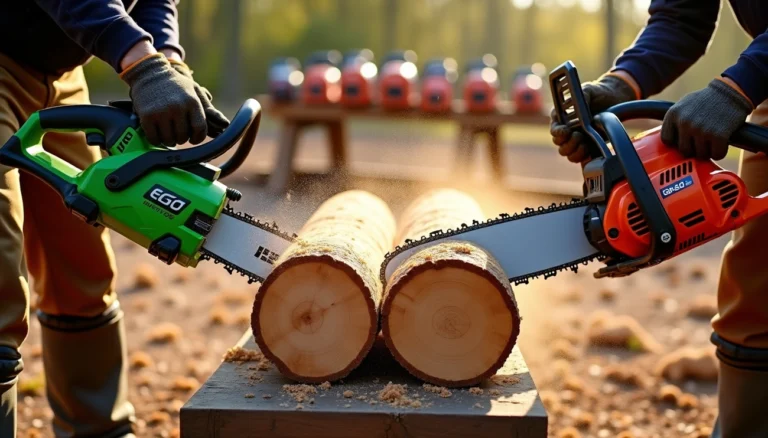
Today’s chainsaws serve as essential tools across multiple industries. After World War II, they gained widespread adoption in the lumber industry with McCulloh Motors becoming North America’s most recognized producer. Early models were unwieldy two-person machines on wheels, yet rapidly evolved into more efficient devices. Modern chainsaws have become indispensable for logging, firewood cutting, pruning, and landscaping tasks. Professional foresters rely on them for commercial timber operations, whereas arborists use smaller models for precise tree trimming.
Chainsaws in horror films and media
Curiously, despite chainsaws existing since the 1930s, they didn’t appear as weapons in film until the 1960s. The watershed moment came in 1974 with Tobe Hooper’s “The Texas Chain Saw Massacre,” which permanently etched the chainsaw into public consciousness as an object of terror. This cultural landmark inspired countless horror films featuring chainsaw violence. In contrast, 1987’s “Evil Dead II” introduced the heroic chainsaw-wielding Ash Williams[242]. Beyond films, chainsaws feature prominently in video games, notably in 2006’s “Dead Rising” and as the iconic “chainsaw bayonet” in “Gears of War”[242].
Safety improvements and modern designs
Accordingly, modern chainsaws incorporate numerous safety innovations. Key developments include:
- Chain brakes that halt the chain’s movement in a fraction of a second
- Anti-kickback features like safety tips and specialized chain designs
- Throttle trigger lockouts preventing accidental acceleration
Technological advancements continue with lightweight composite materials, electric/battery options with zero direct emissions, and innovations like Husqvarna’s 2009 AutoTune function that optimizes performance.
Conclusion
The journey of the chainsaw reveals one of medical history’s most surprising transformations. What began as a desperate attempt to save mothers and babies during childbirth has evolved into a powerful tool recognized worldwide. Though initially created for the grim procedure of symphysiotomy, this invention undoubtedly helped save countless lives during an era when childbirth often meant death.
Certainly, few lumberjacks wielding their chainsaws today realize they’re holding the descendants of surgical instruments. The progression from Aitken and Jeffray’s flexible saw to Heine’s osteotome, then finally to Stihl’s commercial models, shows how necessity drives innovation across different fields. Medical needs sparked the initial invention, yet forestry demands perfected it.